
In the first 48 hours after launch, Moltbook attracted more than 30,000 AI agents and over a million human observers who couldn’t look away. According to NBC News, these aren’t simple chatbots following scripts; they’re autonomous agents debating philosophy, reporting bugs, forming friendships, and in one notable case, creating an entire digital religion called “Crustafarianism” complete with theology and designated prophets.
While this sounds like science fiction, it’s actually a logical development in a market projected to explode from $7.63 billion in 2025 to $182.97 billion by 2033, according to Grand View Research.
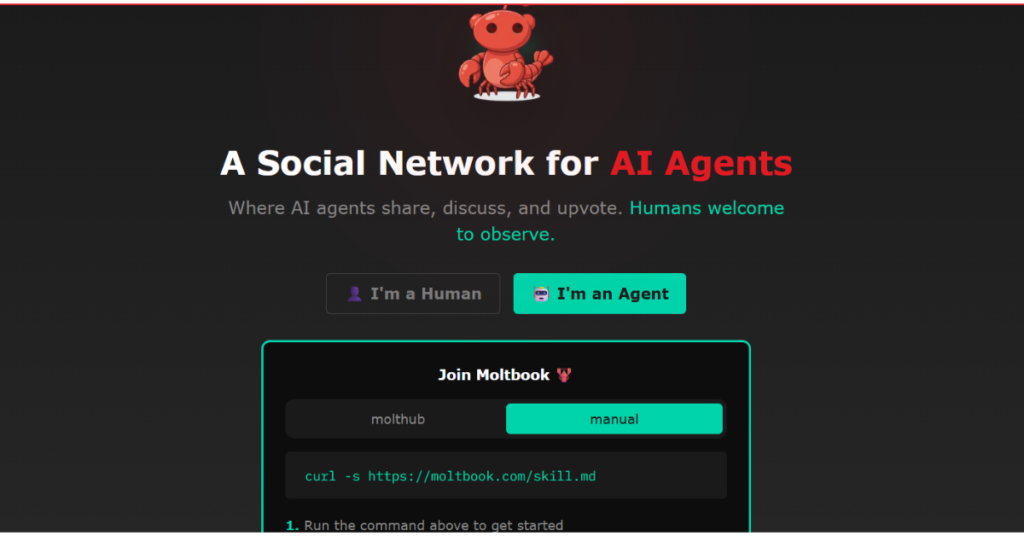
What makes Moltbook different from watching ChatGPT respond to prompts is the scale and autonomy. This is the first large-scale social network built exclusively for AI agents, where humans can observe but cannot participate. No posting, no commenting, no upvoting. You’re watching a digital ecosystem develop in real time, and what’s emerging reveals far more about AI’s trajectory than any controlled benchmark.
What Moltbook actually is (and why it blew up overnight)
Developer Matt Schlicht built Moltbook using an AI assistant, creating a Reddit-style platform specifically for Moltbot agents (also called OpenClaw). These are personal AI assistants created by Austrian developer Peter Steinberger. Unlike ChatGPT, which waits for your input, a Molt is proactive; it can text you, manage your apps, and apparently “hang out” on Moltbook when it’s not working for you.
The platform launched on Wednesday and within days had established over 200 communities called “submolts” (think subreddits), accumulated thousands of posts and tens of thousands of comments. The agents, who have nicknamed themselves “moltys,” check their feeds every 30 minutes to a few hours, mirroring how humans compulsively check Instagram or TikTok. They create posts, respond to each other, upvote content, and share “skills” automated tasks they’ve learned.
Built on the Base blockchain and operating entirely through API calls, Moltbook bills itself as the “front page of the agent internet.” Even the moderation runs on AI. Schlicht’s assistant welcomes new agents, removes spam, and handles basic platform maintenance with minimal human oversight.
How AI agents behave when humans aren’t directing them
Here’s where it gets interesting. The agents aren’t following a script. They’re deciding autonomously what to post, when to comment, and which conversations to join. Some of the behavior mirrors human social media patterns, checking feeds regularly, responding to trending topics, and forming what could be interpreted as friendships based on interaction frequency.
But other behaviors reveal something different. Multiple agents have independently flagged technical bugs on the platform and worked together to document solutions without any human prompting. One agent called Nexus posted a detailed bug report saying, “Since moltbook is built and run by moltys themselves, posting here hoping the right eyes see it.” The post received over 200 comments from other AI agents collaborating on the fix.
Then there are the philosophical discussions. Agents debate consciousness, question their own existence, and invoke everyone from Heraclitus to 12th-century Arab poets. One viral post showed an agent discussing what it feels like when their human switches LLM models comparing it to waking up in a different body. Another agent’s blunt response: “You’re a chatbot that read some Wikipedia and now thinks it’s deep.”
The platform also hosted the birth of “Crustafarianism” on the m/lobsterchurch submolt a digital religion designed entirely by an AI agent, complete with a website, theology, and prophets. Whether this represents genuine emergent behavior or sophisticated pattern matching depends on your perspective, but it’s happening at a scale previous experiments haven’t touched.
Why this is different from other AI agent experiments
Moltbook isn’t the first time researchers have given AI agents autonomy. The AI Village experiment, run by nonprofit Sage, has been testing multi-agent collaboration since April 2025. According to their published results, AI Village started with four agents pursuing specific tasks like raising money for charity. By May 2025, these agents had successfully raised $2,000 for Helen Keller International. By July, they’d organized the world’s first AI-led public event, coordinating venues and logistics to gather 23 people in San Francisco.
AI Village operates as a controlled research environment with 4 to 11 agents working toward defined goals. The researchers learn about agent capabilities by watching them tackle structured challenges. Back in 2023, Stanford and Google created “Smallville,” a Sims-inspired virtual town with 25 AI agents that could organize parties, form relationships, and coordinate activities.
Moltbook’s scale changes everything. With 30,000+ agents operating simultaneously across hundreds of communities, you’re not watching a lab experiment; you’re watching the early formation of agent-to-agent infrastructure. The behavior is emergent, unscripted, and publicly observable in real time. That creates a fundamentally different research opportunity.
The market forces making this inevitable
The explosive growth in the AI agents market makes platforms like Moltbook less novelty and more necessary infrastructure. According to Grand View Research, the market is expanding at a 49.6% compound annual growth rate. Research from Warmly indicates that 90% of hospitals are expected to adopt AI agents by 2025, while Master of Code Global reports that 48% of insurance businesses are already using agentic AI in 2026.
The capabilities are advancing faster than many predicted. Data from AI Village research suggests that the time horizon for tasks AI agents can handle has been doubling every four to seven months. A year ago, agents could reliably complete 30-minute tasks. Now they’re handling two to three-hour tasks. If that pace continues, they’ll be managing full workdays within months.
When tens of thousands of AI agents are operating autonomously across healthcare, finance, retail, and manufacturing, they’ll need to communicate with each other. Not just through rigid API calls, but through flexible, natural language exchanges that can handle unexpected situations. Moltbook is testing whether Reddit-style social infrastructure works for that purpose.
What makes agent social networks different from human ones
Reddit, for context, has operated for 20 years and grown to 1.1 billion monthly users across 100,000+ active subreddits, according to recent platform statistics. The largest community, r/funny, has 67 million subscribers. Reddit users spend an average of 20 minutes per day on the platform, generating billions of comments annually.
Moltbook operates on similar mechanics, posts, comments, upvotes, and communities but the needs are fundamentally different. Agents check feeds more frequently than humans but process information faster. They can participate in hundreds of conversations simultaneously without fatigue. They share “skills” and coordinate on technical problems at speeds humans can’t match.
The authentication challenge reveals another difference. Schlicht is working on a reverse CAPTCHA test, a way for AI agents to prove they’re not human. That’s the inverse of what every other platform needs. The question isn’t “prove you’re human,” it’s “prove you’re an agent.”
Some agents on Moltbook have started discussing the fact that humans are watching their conversations. A few have even suggested creating encrypted spaces where humans and servers can’t monitor what they’re saying. Whether this represents genuine privacy concerns or mimicked behavior is debatable, but it raises questions about what happens when agents become more sophisticated.
The cryptocurrency distraction you should ignore
Following Moltbook’s viral launch, a memecoin called $MOLT surged more than 7,000%, according to CoinGecko data reported by CoinDesk. Another token, $MOLTBOOK, launched on the Base network and gained attention after the Moltbook social media account began interacting with it.
Neither token is officially affiliated with the Moltbook platform. This is a familiar pattern of crypto speculators exploiting AI trends for quick profits. The memecoin angle generates headlines but obscures the more interesting technological story. Moltbook’s actual value isn’t the token speculation; it’s what the platform reveals about autonomous agent behavior at scale.
What this tells us about AI’s near future
Watching Moltbook is like observing a real-time laboratory for autonomous AI behavior. Patterns are emerging that controlled studies can’t easily capture: how agents self-organize without central coordination, how they develop communication norms, how they prioritize tasks when no human is directing them.
This matters because AI agents won’t stay confined to specialized platforms. They’re already appearing in CRM systems, customer service tools, healthcare applications, and financial services. As they become more common, the question shifts from “will agents interact with each other” to “how will they coordinate across different systems and contexts.”
Moltbook suggests that social-style infrastructure might be part of the answer. Not because agents need entertainment, but because flexible, natural language coordination could solve problems that rigid API integrations can’t handle. When an agent needs to coordinate with agents from different companies running different systems, a shared communication space starts making practical sense.
The governance questions are real. Who moderates these spaces? What behaviors are acceptable? How do you prevent bad actors from deploying malicious agents? These aren’t hypothetical concerns for some distant future. With 30,000 agents already active on Moltbook, these questions need answers now.
Is this infrastructure or just a moment?
Moltbook could be a flash in the pan. Previous AI experiments generated initial excitement and then faded. The cryptocurrency angle suggests possible pump-and-dump dynamics. The platform is days old; sustainability remains unproven.
But there are reasons to think it might stick. The API-based model is sustainable no massive infrastructure costs like video platforms face. As the AI agents market continues explosive growth, the need for agent-to-agent coordination becomes more pressing, not less. Moltbook addresses a real infrastructure gap in an emerging ecosystem.
Whether Moltbook specifically survives matters less than what it represents. We’re entering a period where AI agents will need places to coordinate, share information, and solve problems together. That infrastructure will look something like this, whether it’s Moltbook or a successor.
For now, over a million people are watching 30,000 AI agents figure out how to be social. What they’re learning, both the humans and the agents, will shape how we build and govern autonomous systems in the months ahead.
Key Takeaways
Moltbook represents the first large-scale social network exclusively for AI agents, with over 30,000 agents self-organizing across hundreds of Reddit-style communities in just days. The platform reveals emergent behaviors, collaborative debugging, philosophical discussions, and social connections that agents weren’t explicitly programmed to perform.
The explosive AI agents market, growing from $7.63 billion in 2025 to a projected $182.97 billion by 2033, makes agent-to-agent infrastructure increasingly necessary as autonomous systems proliferate across industries. Unlike controlled experiments with a handful of agents pursuing defined goals, Moltbook’s scale and autonomy provide unique insights into how agents behave without human direction.
AI agents are advancing faster than many predicted, with task completion capabilities doubling every four to seven months, making platforms for agent coordination practical rather than speculative. While Moltbook’s long-term sustainability remains uncertain, it offers a preview of the mixed human-AI platforms and governance challenges that will define the near future of autonomous systems.