


An AI certification can strengthen your résumé, but it cannot replace evidence that you can write code, work with data, deploy systems, and solve technical problems. Its value is highest when the credential matches the employer’s platform and the role’s responsibilities.
That matters in 2026 because several certifications still appearing in online recommendations are no longer available. AWS retired Machine Learning – Specialty on March 31, 2026. Microsoft retired Azure Data Scientist Associate on June 1 and Azure AI Engineer Associate on June 30.
The six certifications below support different roles and should be paired with a practical project demonstrating the same skills.
What Makes an AI Certification Valuable?
A useful certification assesses knowledge against a defined role, uses a proctored exam, and covers skills found in production work.
Before paying for an exam, ask:
- Does it match the platform used by your target employers?
- Does it cover deployment, monitoring, security, evaluation, or operations?
- Is it intended for your experience level?
- Can you build a portfolio project around its objectives?
- Will it remain current when you start applying?
Course-completion certificates can help you learn, but they do not carry the same signal as a role-based professional certification. Even a respected certification remains supporting evidence, not proof that you can perform the job without supervision.
| Certification | Best fit | Level | Main limitation |
|---|---|---|---|
| Google Professional ML Engineer | GCP machine learning | Advanced | GCP-specific |
| AWS ML Engineer – Associate | AWS ML and MLOps | Intermediate | Requires AWS practice |
| AWS GenAI Developer – Professional | Production generative AI | Advanced | Too advanced for beginners |
| Microsoft AI-103 | Azure apps and agents | Intermediate | Limited outside Azure |
| Microsoft AI-300 | Azure MLOps and GenAIOps | Intermediate | Operations-focused |
| Databricks ML Professional | Enterprise lakehouse ML | Advanced | Databricks-specific |
1. Google Cloud Professional Machine Learning Engineer
Best for: Experienced ML engineers targeting Google Cloud machine learning roles using Gemini Enterprise Agent Platform and related Google Cloud services.
Google’s Professional Machine Learning Engineer certification covers designing, building, deploying, operationalizing, and securing machine-learning systems on Google Cloud. The exam costs $200, has no formal prerequisite, and recommends at least three years of industry experience, including one year designing and managing Google Cloud solutions.
This is a strong option for candidates who understand model development and want to prove they can take ML systems into production. It is less suitable for beginners learning Python or machine-learning fundamentals.
Pair it with a Vertex AI project that trains a model, registers it, deploys an endpoint, monitors performance, and documents the decisions made.
2. AWS Certified Machine Learning Engineer – Associate
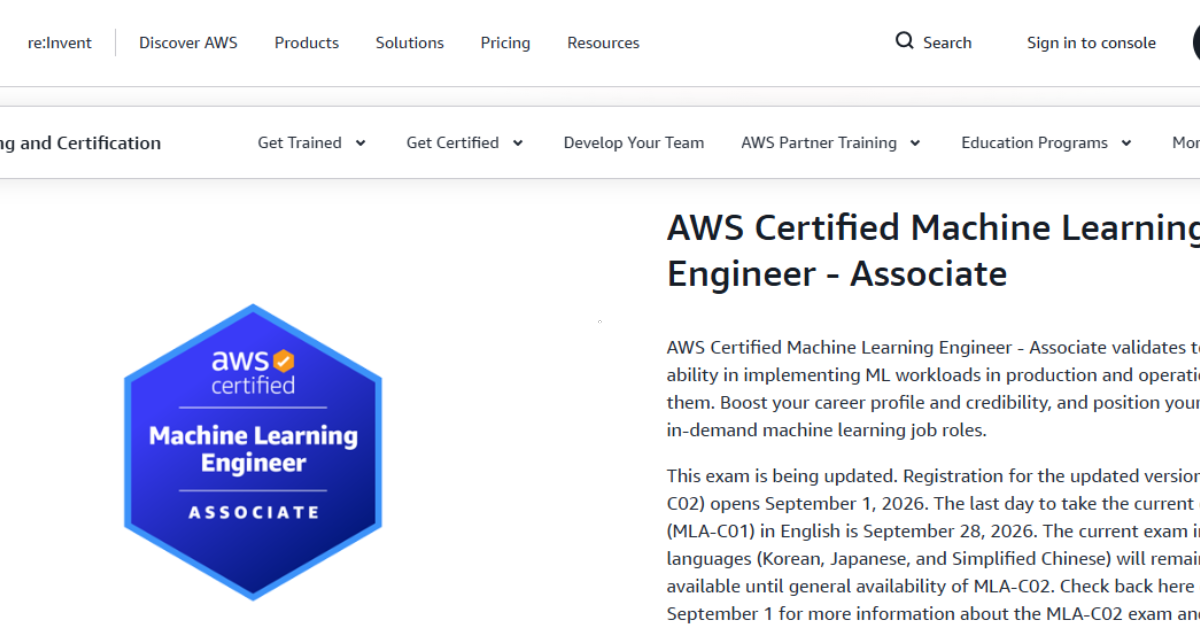
Best for: Developers, data engineers, data scientists, and MLOps engineers working on AWS.
This $150 associate certification validates the ability to implement and operationalize production ML workloads. AWS targets candidates with at least one year of experience using SageMaker and other AWS machine-learning services. The current exam contains 65 questions and lasts 130 minutes.
Candidates registering later in 2026 must watch the exam transition. Registration for the English MLA-C02 beta opens on September 1, 2026, with beta testing beginning September 29. The standard updated exam is expected in early 2027.
The updated version adds generative AI, foundation-model, and agentic-AI workloads.
Pair it with a SageMaker pipeline covering automated training, deployment, monitoring, and retraining.
3. AWS Certified Generative AI Developer – Professional
Best for: Experienced developers building production generative AI systems on AWS.
This is not an introductory prompting credential. AWS designed it for developers who build and deploy production-ready generative AI applications using services such as Amazon Bedrock. The exam costs $300, lasts 180 minutes, and contains 75 multiple-choice or multiple-response questions. AWS recommends at least two years of production application experience and one year implementing generative AI solutions.
Its value comes from covering concerns that separate a prototype from a deployable application: security, cost control, infrastructure, monitoring, and operational reliability.
Pair it with a retrieval application that includes evaluation, access controls, guardrails, observability, and a documented cost model. Skip it for now when your experience consists mainly of chat interfaces or small API demos.
4. Microsoft Azure AI Apps and Agents Developer Associate
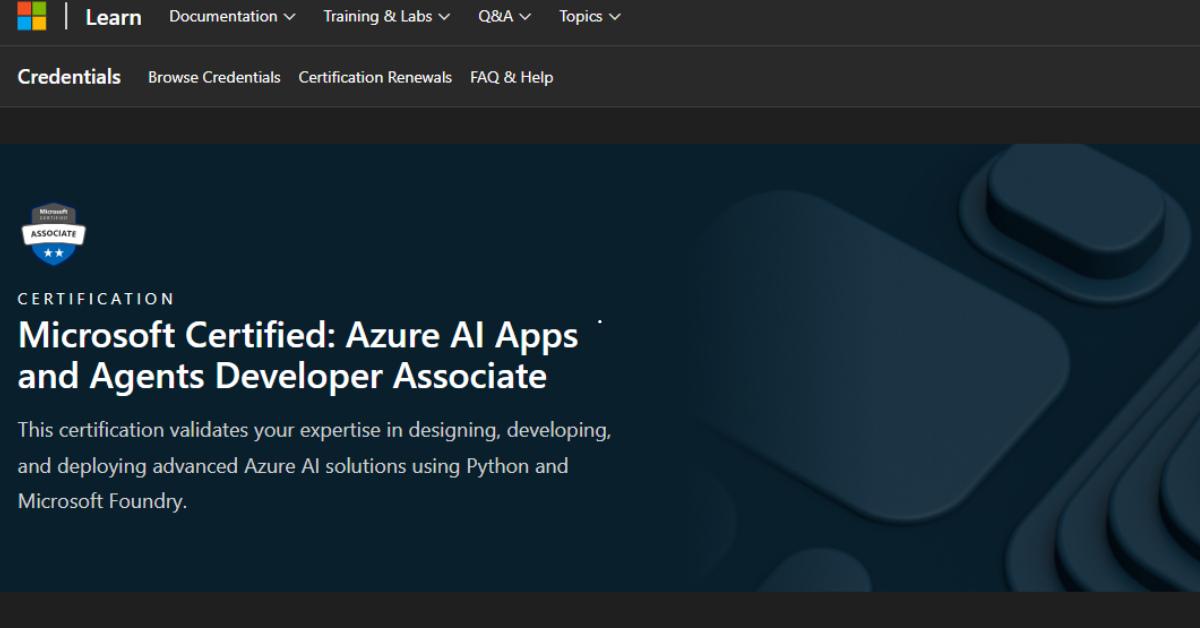
Best for: Python developers building Azure AI applications and agents.
The AI-103 certification validates the ability to design, develop, and deploy AI solutions using Python, Azure, and Microsoft Foundry. Its scope includes generative AI, agentic systems, computer vision, text analysis, and information extraction. The proctored assessment lasts 120 minutes, with pricing determined by the candidate’s country or region.
Choose it when your target jobs involve application development on Azure rather than training custom models from first principles. It demonstrates platform knowledge, but not broad expertise in statistics, experimentation, or ML research.
Pair it with an Azure-hosted agent that retrieves private documents, calls approved tools, returns structured outputs, and includes evaluation and monitoring.
5. Microsoft Machine Learning Operations Engineer Associate
Best for: Azure MLOps, GenAIOps, platform engineering, and AI operations roles.
AI-300 focuses on operating machine-learning models, generative AI applications, and agents after development. Microsoft expects candidates to understand Python, Azure Machine Learning, Microsoft Foundry, GitHub Actions, command-line tools, infrastructure as code, deployment, evaluation, monitoring, and optimization.
The distinction from AI-103 is practical: AI-103 focuses on building AI applications, while AI-300 covers the infrastructure and processes that deploy, test, observe, and maintain them.
It is not a sensible starting point for someone who has never deployed software. Pair it with a version-controlled pipeline that provisions infrastructure, runs evaluations, deploys automatically, monitors quality, and supports rollback.
6. Databricks Certified Machine Learning Professional
Best for: Experienced ML engineers working in Databricks and lakehouse environments.
Databricks’ professional exam covers model development, MLOps, and deployment at enterprise scale. Its objectives include testing, environment management, automated retraining, model serving, rollout management, and drift monitoring. The proctored exam costs $200, contains 59 scored questions, lasts 120 minutes, and recommends more than one year of hands-on experience. It is valid for two years.
This is a credible specialization when target employers use Databricks, MLflow, Spark, or lakehouse architecture. It offers less value for roles built entirely around another platform.
Pair it with an MLflow-managed project covering feature preparation, experiment tracking, registration, deployment, monitoring, and retraining.
A Certification Needs Supporting Evidence
One relevant certification paired with a strong project is usually more convincing than several unrelated badges. The project should show what an exam cannot fully demonstrate: code quality, architecture decisions, testing, debugging, documentation, cost awareness, security, and operational judgment.
Publish the source code where possible. Include an architecture diagram, setup instructions, evaluation results, known limitations, and an explanation of your service choices. Tailor your résumé to roles using the same ecosystem rather than listing the certification without context.
For entry-level candidates, the portfolio may carry more weight than the credential. For experienced candidates, certification can make existing experience easier to verify.
Choose the Certification That Matches the Job
Choose Google Cloud Professional Machine Learning Engineer for established GCP-focused ML work. Select AWS Machine Learning Engineer – Associate for production ML and MLOps on AWS, or AWS Generative AI Developer – Professional when you already build advanced generative AI systems.
On Azure, AI-103 suits application and agent development, while AI-300 suits MLOps and GenAIOps. Databricks Machine Learning Professional fits enterprise teams using Databricks and MLflow.
The certification that helps most is not the one with the most recognizable logo. It is the one that supports the job you are applying for and is backed by a project proving that you can use those skills.

