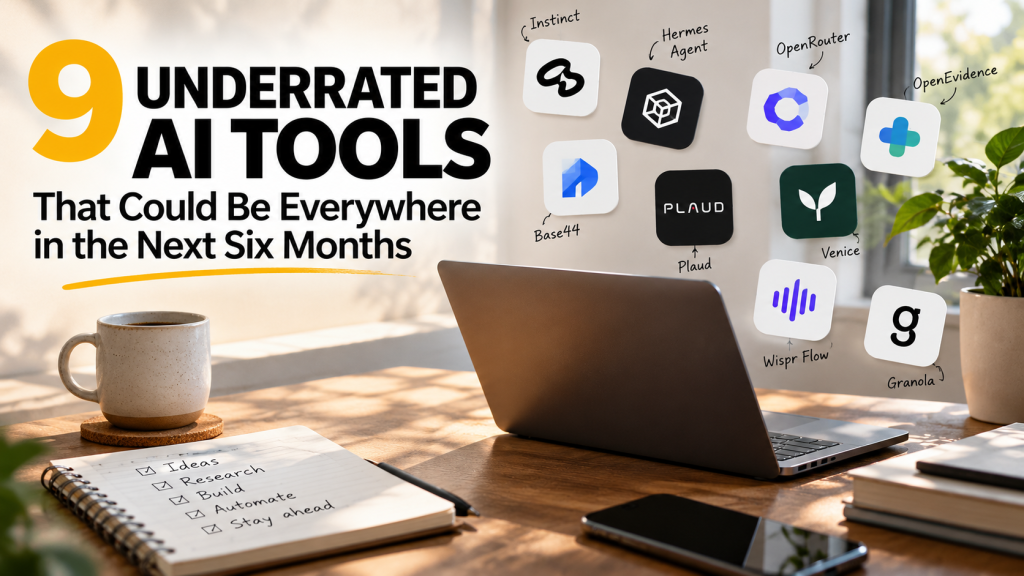

Something changed how I think about AI tools. In October 2026, a16z ranked the top consumer AI apps and found that 29 of the top 50 companies by consumer spending don’t appear on any web or mobile traffic list. The same report counted just 11 new names on the traffic charts, the fewest in seven editions.
So the tools people pay for are often not the tools people talk about. That gap is where underrated AI tools live.
Below are nine I think could go mainstream between now and April 2027, with the numbers behind each one and what you should know first.
1. Instinct
Instinct is a personal assistant you text on iMessage or WhatsApp, or simply call. It books, buys, and plans for you.
It is still invite-only, yet founder Noah Shinn says close to $1 billion in yearly transactions already runs through it, and a new $1 billion round valued the company at $10 billion. It is free to use.
You hand it your cards and accounts, and Meta’s rival agent, Muse, crossed 5 million downloads in under a month.
Of all nine, this is the one I’m least sure about. Distribution often beats a better product.
2. Hermes Agent
Hermes Agent, from Nous Research, is an open-source assistant that writes its own “skills” as it learns how you work.
It runs on a $5 server, and you can talk to it from Telegram. The GitHub repo has over 256,000 stars, and it is barely 15 months old. The software is free under the MIT license.
You set it up yourself and pay for the AI model it runs on.
3. OpenRouter
OpenRouter gives developers one account and one API to reach models from dozens of AI labs.
Weekly usage grew from 0.5 trillion tokens in January 2025 to 128.4 trillion in September 2026, roughly 250 times bigger.
OpenRouter does not mark up model prices, but it charges a 5.5% fee when you buy credits, and unused credits can expire after a year.
This is my strongest bet. As companies mix cheaper open models with premium ones, a neutral switchboard matters more every month.
4. OpenEvidence
Most people have never heard of OpenEvidence, yet about 65% of U.S. doctors use it.
It answers clinical questions using licensed journals like NEJM and JAMA, and it is free for verified clinicians.
It just raised at a $15 billion valuation, and Forbes reports plans to roll it out free across nearly 100 countries, with Africa named as a focus.
One study, not yet peer-reviewed, found it answered complex questions correctly less than 45% of the time. It also runs ads, some from drug companies.
5. Base44
Base44 lets you describe an app in plain English and get the whole thing built, database and logins included.
Wix bought it in 2025, and its yearly revenue run rate doubled from $100 million to $200 million in five months. Wix says it will put the savings from its own AI model into marketing.
The free plan gives you 25 message credits a month.
That is enough to test an idea, not to finish one. Starter is $16 a month, billed yearly.
6. Plaud
Plaud sells small recorders that clip to your shirt or stick to your phone and turn conversations into notes.
It has shipped over 2 million devices, and its subscription business passed $100 million a year.
AI hardware has very few success stories, which is why this one stands out.
The device costs about $179, and the free plan covers 300 minutes a month. Unlimited costs $29.99 monthly.
You also need consent before recording anyone.
7. Venice
Venice is a private chat app with over 200 models that stores your history on your device.
It has more than 3 million active users and is already profitable, with over $70 million in yearly revenue.
The free plan allows 10 text prompts a day, and Pro is $18 a month.
Its “uncensored” stance and crypto tokens will put many people off.
I expect it to grow fast but stay a strong niche product rather than a default.
8. Wispr Flow
Wispr Flow turns your speech into clean text inside any app.
People have written over 60 billion words with it, and its new speech model cuts errors in noisy places from over 30% to 5%-10%.
It just raised $280 million at a $2 billion valuation.
The free plan caps desktop dictation at 2,000 words a week, and Pro costs $15 per user a month.
Its new Notetaker only runs on Mac and Windows for now.
9. Granola
Granola takes meeting notes without sending a bot into your call.
It raised $125 million at a $1.5 billion valuation, and it already works as an official connector inside Claude and ChatGPT, so your meeting history can feed other AI tools.
Free accounts only keep 30 days of meeting history. Business is $14 per user per month.
Wispr and Plaud are now competing in the same note-taking market.
How to Pick From These Underrated AI Tools
Do not sign up for all nine. Pick the one that matches a task you repeat every week.
If you write a lot, try Wispr Flow’s free plan for seven days and count the minutes you save.
If you build software, put $10 of credits on OpenRouter and test three models on the same prompt.